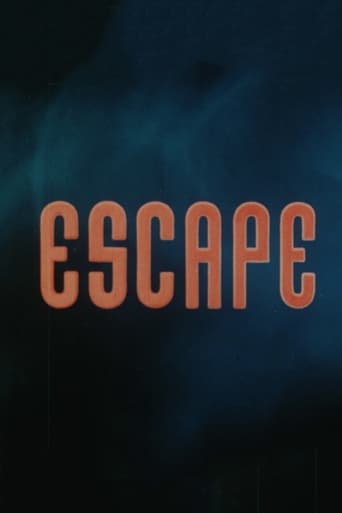
Escape (Synchronomy No. 4) (1937)
10 votes
To the toccata portion of Bach's "Toccata and fugue in D minor," we watch a play of sorts. Blue smoke forms a background; a grid of black lines is the foreground. Behind the lines, a triangle appears, then patterns of multiple triangles. Their movements reflect the music's rhythm. Behind the barrier of the black lines, the triangle moves, jumps, and takes on multiple shapes. In contrast with the blue and the black, the triangles are warm: orange, red, yellow. The black lines bend, swirl into a vortex, then disappear. The triangle pulsates and a set of many of them rises.
Leer el reportaje de Escape (Synchronomy No. 4) →Movie DNA
Títulos similares
Más Animación → Momento
 Momento
 Momento
 Momento
 Momento
 Momento
 Momento
 Momento
 Momento
 Momento
 Momento
 Momento
Frequently asked questions about Escape (Synchronomy No. 4)
What is Escape (Synchronomy No. 4) about?
To the toccata portion of Bach's "Toccata and fugue in D minor," we watch a play of sorts. Blue smoke forms a background; a grid of black lines is the foreground. Behind the lines, a triangle appears, then patterns of multiple triangles. Their movements reflect the music's rhythm. Behind the barrier of the black lines, the triangle moves, jumps, and takes on multiple shapes. In contrast with the blue and the black, the triangles are warm: orange, red, yellow. The black lines bend, swirl into a vortex, then disappear. The triangle pulsates and a set of many of them rises.
How long is Escape (Synchronomy No. 4)?
Escape (Synchronomy No. 4) has a runtime of 4 minutes.