Money: A Tragicomic Saga (1946): cast, story & where to watch
1946 · Film · ★ 7.1
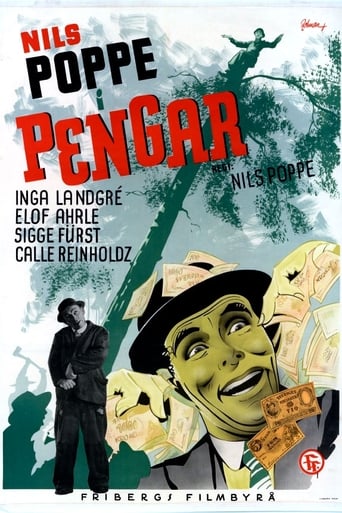
Released in 1946, Money: A Tragicomic Saga is a comedy film directed by Nils Poppe, running about 97 minutes.
What it’s about. Orvar is a vagabond, walking the country roads and living on sunshine and generosity. One day he decides to find work somewhere to get some money. He becomes a helping hand for seven lumberjack brothers. The big and strong brothers really enjoy themselves, joking with the small and meek Orvar. Orvar does not know that he has inherited a large fortune but the seven brothers do and they begin to treat him with the greatest courtesy. They convince him to write his last will, making them his heirs, and then begin to make plans on how to kill him.
Who’s in it. Money: A Tragicomic Saga stars Nils Poppe as Harry Orvar Larsson, Sigge Fürst as Sigvard "Sigge" Vildsint, Carl Reinholdz as Kalle Svagsint and Hilding Rolin as Hilding Argsint, among others.
How it landed. With an audience score of 7.1/10, Money: A Tragicomic Saga has been warmly received by audiences.
Where to watch. In GB you can stream it on Netflix and Netflix Standard with Ads. See the full, country-by-country breakdown on our where to watch Money: A Tragicomic Saga page.
If you liked it. Fans of Money: A Tragicomic Saga tend to enjoy Forrest Gump, Parasite, Life Is Beautiful and Fight Club.
Frequently asked
- Where can I watch Money: A Tragicomic Saga (1946)?
- In GB, Money: A Tragicomic Saga is available to stream on Netflix and Netflix Standard with Ads. Availability varies by country — check our where-to-watch page for every region.
- Is Money: A Tragicomic Saga worth watching?
- Money: A Tragicomic Saga holds an audience score of 7.1 out of 10, and is a strong pick if you enjoy comedy. Most viewers rate it highly.
- Who stars in Money: A Tragicomic Saga?
- Money: A Tragicomic Saga stars Nils Poppe, Sigge Fürst, Carl Reinholdz, Hilding Rolin and Birger Åsander.
- When was Money: A Tragicomic Saga released?
- Money: A Tragicomic Saga was released in 1946, with a runtime of about 97 minutes.