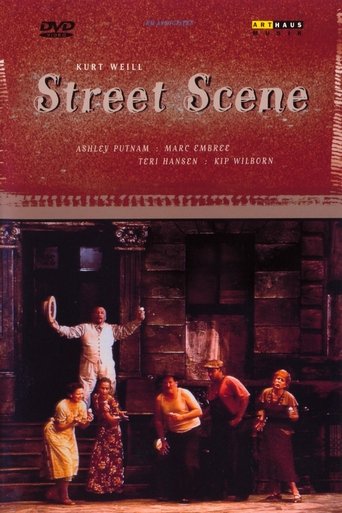
Kurt Weill: Street Scene (2002)
Original title: Kurt Weill - Street Scene
Street Scene is a Broadway musical or, more precisely, an "American opera" by Kurt Weill (music), Langston Hughes (lyrics), and Elmer Rice (book). It was based on the Pulitzer Prize-winning play of the same name by Rice. For his work on Street Scene, Weill received the first Tony Award for Best Original Score. In Germany, in the late 1920s and early 1930s, Weill had already begun to use American jazz and popular song elements in his operas. After fleeing from Germany in 1933, he worked in Paris, then England, and then, beginning in 1935, in New York. Weill made a study of American popular and stage music and worked to further adapt his music to new American styles in his writing for Broadway, film and radio. He strove to find a new way of creating an American opera that would be both commercially and artistically successful.
Lire le dossier sur Kurt Weill: Street Scene →Distribution principale
Distribution et équipe complètes →
Movie DNA
Frequently asked questions about Kurt Weill: Street Scene
What is Kurt Weill: Street Scene about?
Street Scene is a Broadway musical or, more precisely, an "American opera" by Kurt Weill (music), Langston Hughes (lyrics), and Elmer Rice (book). It was based on the Pulitzer Prize-winning play of the same name by Rice. For his work on Street Scene, Weill received the first Tony Award for Best Original Score. In Germany, in the late 1920s and early 1930s, Weill had already begun to use American jazz and popular song elements in his operas. After fleeing from Germany in 1933, he worked in Paris, then England, and then, beginning in 1935, in New York. Weill made a study of American popular and stage music and worked to further adapt his music to new American styles in his writing for Broadway, film and radio. He strove to find a new way of creating an American opera that would be both commercially and artistically successful.